

Altruistic Surrogacy Centre in Delhi — Legal Process, Cost & Eligibility 2026
Surrogacy in Delhi offers hope to thousands of couples every year who are unable to carry a pregnancy due to medical conditions. At KIC Delfinium Fertility Centre, South Extension I, New Delhi, altruistic surrogacy is conducted with the highest standards of medical care, legal compliance, and emotional sensitivity — guided by Dr. Nalini Gupta, one of India’s most experienced fertility specialists with over 30 years in reproductive medicine.
Surrogacy is a deeply personal and legally significant journey. In India, surrogacy is governed by strict national legislation that permits only altruistic surrogacy — meaning the surrogate mother receives no commercial payment for carrying the pregnancy. This framework exists to protect the dignity and health of surrogate mothers while ensuring that intended parents can access this life-changing option through a regulated, ethical process.
India’s surrogacy laws have evolved considerably between 2021 and 2026, and navigating the legal, medical, and emotional dimensions of this path requires expert guidance from a centre experienced in all three. KIC Delfinium has helped hundreds of families through this process, providing end-to-end support from eligibility assessment through to the safe delivery of the baby and completion of all legal formalities.
This guide covers everything you need to know about altruistic surrogacy in Delhi in 2026 — including current laws, eligibility criteria, the complete step-by-step process, a transparent cost breakdown, required documents, and frequently asked questions.
Calculate Altruistic Surrogacy Cost Now
Surrogacy Laws in India 2024–2026
Understanding the legal landscape is the essential first step for any couple considering surrogacy in India. The law has changed significantly in recent years, and operating within the correct legal framework is non-negotiable.
The Surrogacy (Regulation) Act, 2021
The Surrogacy (Regulation) Act, 2021 came into force to establish a comprehensive legal framework for surrogacy in India. Before this Act, India had no dedicated surrogacy legislation, leaving both intended parents and surrogate mothers vulnerable to exploitation and legal uncertainty.
The Act makes several critical determinations:
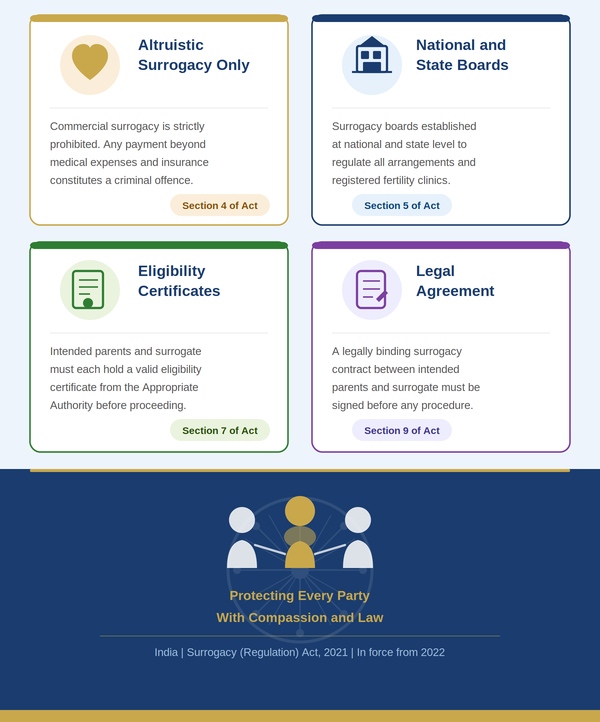
Only altruistic surrogacy is permitted. Commercial surrogacy — where a surrogate is paid a fee beyond medical expenses and insurance — is explicitly prohibited. Any arrangement involving financial compensation to the surrogate beyond her direct medical care constitutes a criminal offence under the Act.
A National Surrogacy Board and State Surrogacy Boards have been established to regulate and oversee all surrogacy arrangements. Fertility clinics offering surrogacy services must be registered with the appropriate authority.
Intended parents must obtain an eligibility certificate from the Appropriate Authority before proceeding with any surrogacy arrangement. Similarly, the surrogate must obtain a certificate of eligibility confirming she meets all legal criteria.
A surrogacy agreement — a legally binding contract between the intended parents and the surrogate — must be executed before any medical procedures begin.
2024 Amendments — Key Changes
The 2024 amendments to the Surrogacy (Regulation) Act introduced important modifications that directly affect intended parents and surrogates:
The requirement that the surrogate must be a close relative of the intended couple was a point of significant practical difficulty for many families. Legal challenges and parliamentary review led to clarifications around the definition and application of this requirement. As of 2026, legal interpretation continues to evolve — making it essential to consult with a surrogacy-experienced fertility centre like KIC Delfinium and an independent legal advisor before proceeding.
Additionally, amendments clarified provisions around donor gametes — the use of donor eggs in surrogacy arrangements is permitted under specific conditions, expanding access for women who cannot produce their own eggs.
What “Altruistic“ Means in Practice
Altruistic surrogacy means the surrogate mother chooses to carry the pregnancy out of compassion and goodwill — not financial gain. Under Indian law, intended parents may cover:
- All medical expenses related to the surrogate’s pregnancy and delivery
- Health insurance for the surrogate (mandatory under the Act)
- Reasonable expenditure on nutrition, clothing, and travel directly related to the pregnancy
What they cannot pay is a fee, salary, or any form of compensation for the act of surrogacy itself. This distinction is both legal and ethical — and KIC Delfinium’s team ensures all arrangements are structured accordingly.

Eligibility Criteria for Surrogacy in India 2026
The Surrogacy (Regulation) Act sets specific eligibility criteria for both intended parents and surrogate mothers. Understanding these requirements early prevents wasted time and heartbreak.
Eligibility Criteria for Intended Parents
For the intended couple to qualify for surrogacy in India, they must meet all of the following conditions:
✅ Must be a legally married Indian couple (marriage certificate required) ✅ The wife must be between 23 and 50 years of age ✅ The husband must be between 26 and 55 years of age ✅ Must have a medical necessity certificate issued by a registered medical practitioner confirming that the intended mother cannot carry a pregnancy herself ✅ Must not have any surviving child (biological, adopted, or through surrogacy) — except where the existing child is mentally or physically challenged or suffers from a life-threatening disorder ✅ Must obtain an Eligibility Certificate from the Appropriate Authority before proceeding
Medical Conditions That Qualify as Necessity for Surrogacy
The intended mother may qualify for surrogacy if she has:
- Absent or surgically removed uterus
- Congenital uterine anomaly (e.g., Rokitansky syndrome)
- Repeated IVF implantation failures
- Recurrent pregnancy loss with an identified uterine cause
- A medical condition that makes pregnancy life-threatening
Eligibility Criteria for the Surrogate Mother
The surrogate must meet all of the following criteria:
✅ Must be married and have her own biological child ✅ Must be between 25 and 35 years of age ✅ Can act as surrogate only once in her lifetime ✅ Must provide written informed consent — as must her husband ✅ Must be medically and psychologically fit as assessed by registered medical practitioners ✅ Must not be the egg donor for the same surrogacy arrangement ✅ Must have an insurance policy covering health, life, and post-delivery complications (cost borne by intended parents)
Who Cannot Opt for Surrogacy in India
The law explicitly excludes the following from surrogacy arrangements:
❌ Unmarried individuals (single men or single women) ❌ Homosexual couples ❌ Live-in or cohabiting couples without legal marriage ❌ Foreign nationals (even if married to an Indian citizen — specific restrictions apply) ❌ NRI couples (Non-Resident Indians) — subject to specific legal restrictions as of 2026 ❌ Couples who already have a healthy surviving child
Step-by-Step Surrogacy Process at KIC Delfinium
The surrogacy journey at KIC Delfinium is structured, transparent, and supported at every stage by medical and legal expertise.
Step 1: Initial Consultation and Eligibility Assessment
Your journey begins with a detailed consultation with Dr. Nalini Gupta and the KIC Delfinium surrogacy counselling team. During this session, your complete medical history is reviewed, the medical necessity for surrogacy is assessed, and the eligibility of both intended parents under the current legal framework is evaluated.
This is also the stage at which you will receive a clear explanation of the entire process, realistic timelines, costs, and what the journey ahead will involve emotionally and practically. There is no pressure and no obligation — only honest, expert guidance.
Step 2: Legal Documentation and Agreements
Before any medical procedures begin, all required legal documentation must be in place. This includes:
- Application for Eligibility Certificate from the Appropriate Authority (for both intended parents and surrogate)
- A legally drafted and executed surrogacy agreement covering the rights, responsibilities, and medical care provisions for all parties
- Consent documentation from the surrogate and her husband
KIC Delfinium works with experienced reproductive law practitioners and can provide referrals to help families complete this stage correctly. The legal process takes time and should not be rushed.
Step 3: Medical Screening of the Surrogate
Once the surrogate has been identified and has given preliminary consent, she undergoes comprehensive medical and psychological evaluation. This includes:
- Complete blood work (infectious disease screening, blood group, hormone levels)
- Uterine assessment via sonography and hysteroscopy
- Psychological counselling and assessment
- General health evaluation
Only surrogates who pass all medical and psychological criteria proceed to the treatment stage.
Step 4: IVF Cycle — Egg Retrieval and Fertilisation
The intended mother (or an egg donor, if medically necessary) undergoes an IVF cycle at KIC Delfinium. This involves ovarian stimulation, follicle monitoring, egg retrieval under sedation, and laboratory fertilisation of the retrieved eggs with the intended father’s sperm (or donor sperm, if applicable).
If the intended mother cannot use her own eggs, donor eggs may be sourced under the provisions of the ART (Assisted Reproductive Technology) Regulation Act, 2021. Egg freezing may also be utilised if eggs have been previously banked by the intended mother.
Similarly, if sperm freezing has been performed in advance — for example, if the intended father has a condition affecting sperm production — frozen sperm can be used at this stage.
Step 5: Embryo Transfer to the Surrogate
The best-quality embryo (or embryos, as clinically advised) are transferred to the surrogate’s uterus during a frozen or fresh embryo transfer cycle. The surrogate’s uterine lining is prepared with hormonal support to optimise implantation. The transfer itself is a simple, non-surgical procedure taking 10–15 minutes.
Step 6: Pregnancy Monitoring
Following a confirmed pregnancy (via beta-hCG blood test 14 days after transfer), the surrogate receives full antenatal care throughout the pregnancy. KIC Delfinium coordinates regular monitoring, and all medical decisions are made with the surrogate’s health and wellbeing as the priority — as required by law. The intended parents are kept informed at every stage.
Step 7: Delivery and Parentage Order
The delivery is planned at a hospital with appropriate neonatal facilities. After the birth, the intended parents must obtain a parentage order from the appropriate court, legally establishing them as the child’s parents. This step is a mandatory legal requirement and must be completed before the child’s birth certificate can be issued in the intended parents’ names.
KIC Delfinium’s team will guide you on the legal process and the documentation required at this final stage.
Surrogacy Cost in Delhi 2026
Altruistic surrogacy in India is significantly more affordable than surrogacy in the UK, USA, or most European countries — where commercial surrogacy may cost ₹50,00,000 or more. In Delhi, the total cost of an altruistic surrogacy arrangement varies depending on the medical protocol, legal complexity, and surrogate care requirements.
Surrogacy Cost Breakdown Table
|
Component |
Estimated Cost (₹) |
|
IVF Cycle (egg retrieval, fertilisation, embryo culture) |
₹1,00,000 – ₹2,00,000 |
|
Ovarian Stimulation Medications |
₹30,000 – ₹80,000 |
|
Frozen Embryo Transfer (FET) to Surrogate |
₹20,000 – ₹40,000 |
|
Surrogate Medical Screening |
₹15,000 – ₹30,000 |
|
Surrogate Antenatal Care & Monitoring |
₹50,000 – ₹1,00,000 |
|
Delivery Charges (normal or caesarean) |
₹50,000 – ₹1,50,000 |
|
Surrogate Health & Life Insurance (mandatory) |
₹30,000 – ₹50,000 |
|
Nutrition, Clothing & Travel for Surrogate |
₹30,000 – ₹60,000 |
|
Legal Documentation & Agreements |
₹50,000 – ₹1,50,000 |
|
Eligibility Certificate Applications |
₹10,000 – ₹20,000 |
|
Parentage Order (Court Process) |
₹30,000 – ₹80,000 |
|
TOTAL (Estimated Range) |
₹4,00,000 – ₹8,00,000 |
Please note: These are indicative ranges. The actual cost will depend on the specific medical protocol required, the number of IVF cycles needed, legal fees in your specific state, and any complications during pregnancy or delivery. A personalised cost estimate is provided during your consultation at KIC Delfinium.
Costs do not include any payment to the surrogate as compensation — as this is prohibited under Indian law.
Required Documents for Surrogacy in India
Having your documentation in order before beginning the process avoids significant delays. Below is a checklist of documents typically required:
For Intended Parents: ✅ Marriage certificate (registered) ✅ Age proof (Aadhaar, passport, or birth certificate) for both husband and wife ✅ Medical necessity certificate issued by a registered medical practitioner ✅ Proof of Indian citizenship for both partners ✅ Application for Eligibility Certificate to the Appropriate Authority ✅ Photographs (passport size)
For the Surrogate: ✅ Marriage certificate ✅ Birth certificate of her existing biological child ✅ Age proof (Aadhaar or passport) ✅ Written informed consent from the surrogate ✅ Written consent from the surrogate’s husband ✅ Medical fitness certificate ✅ Psychological assessment report
Legal Documents: ✅ Drafted and signed surrogacy agreement (before any medical procedure) ✅ Eligibility certificate issued by the Appropriate Authority (for both parties) ✅ Insurance policy covering the surrogate’s health, life, and delivery complications
All documents must be verified and in order before any clinical procedures commence. KIC Delfinium’s counselling team will provide a detailed document checklist specific to your state and situation during your initial consultation
Surrogacy Success Rates at KIC Delfinium
Surrogacy success rates are directly linked to the quality of the IVF programme, the embryology laboratory, and the clinical expertise of the fertility team — all of which are central strengths of KIC Delfinium.
Because the surrogate’s uterus is typically healthy and has previously supported a successful pregnancy, implantation rates in surrogacy are often higher than in standard IVF cycles where the intended mother’s uterine environment may be compromised.
At KIC Delfinium, the IVF programme that underpins every surrogacy cycle reports pregnancy success rates of 38–42% per embryo transfer, with cumulative rates across two or three attempts reaching 60–70% for most couples. Over 8,000 successful deliveries have been achieved at the centre since 1980, reflecting four decades of consistent clinical excellence.
The use of vitrified (rapidly frozen) embryos for transfer to the surrogate — a standard practice at the centre — ensures that only the highest-quality embryos are used, maximising the chance of a successful, healthy pregnancy.
Emotional and Legal Support Throughout Your Journey
Surrogacy is not only a medical process — it is one of the most emotionally significant journeys a family can undertake. The anticipation, the legal complexity, the relationship with the surrogate, and the long months of waiting all carry profound emotional weight.
KIC Delfinium provides dedicated counselling support for intended parents at every stage of the process. This includes pre-treatment psychological preparation, guidance on managing the waiting period, and support in the event that a cycle does not succeed and further attempts are needed.
For the surrogate, psychological counselling is equally important — and legally required. The centre ensures all surrogates receive independent counselling, understand their rights fully, and enter the arrangement with complete, free, and informed consent. The wellbeing of the surrogate is treated as a clinical and ethical priority, not an afterthought.
On the legal side, the team’s familiarity with the Surrogacy (Regulation) Act and its 2024 amendments means intended parents are guided through the application process for eligibility certificates, the surrogacy agreement, and the post-birth parentage order with accuracy and care.
Why Choose KIC Delfinium as Your Surrogacy Centre in Delhi
Choosing the right centre for surrogacy is one of the most consequential decisions a couple will make. Here is why KIC Delfinium is a trusted choice for families across Delhi NCR and beyond.
Decades of Experience: With over 40 years in fertility medicine and more than 40,000 couples supported, KIC Delfinium brings clinical depth that few centres can match. Complex surrogacy cases — including those involving donor eggs, prior failed attempts, or older intended mothers — are handled with the expertise that only genuine experience provides.
Legal Compliance: The centre operates in full compliance with the Surrogacy (Regulation) Act 2021 and its amendments. Every arrangement is structured to protect all parties legally — the intended parents, the surrogate, and the child.
Advanced IVF Laboratory: The surrogacy process depends entirely on the quality of the IVF cycle and embryo. KIC Delfinium’s state-of-the-art laboratory, led by Dr. Nalini Gupta’s UK-trained embryology expertise, ensures the highest standards of fertilisation, embryo culture, and cryopreservation.
Transparent Pricing: There are no hidden costs and no financial surprises. Intended parents receive a clear, itemised cost estimate at the outset, with honest communication about what may vary.
Compassionate Care: The centre’s approach to surrogacy is built around dignity — for the surrogate, for the intended parents, and for the child. Every family is treated as unique.
Get a Free Fertility Consultation
Now that you have decided to give fertility treatments a try, then the next possible step is to get consulted. So contact us now and have your face-to-face consultation arranged with our great fertility experts. You can get a consultation over a video call or voice call.
You just have to fill out the contact form or give our friendly staff a call at +91 9599754455. We are happy to help you in your journey to parenthood and give you the best assistance as you move through the arduous infertility process.
Book Free Fertility Consultation
Frequently Asked Questions — Surrogacy in Delhi 2026
- 1. Is surrogacy legal in India in 2026?
Yes, altruistic surrogacy is legal in India under the Surrogacy (Regulation) Act 2021 and subsequent amendments. Commercial surrogacy — where the surrogate receives payment beyond medical expenses — is prohibited. All surrogacy arrangements must be approved by the Appropriate Authority, and a legally binding surrogacy agreement must be in place before any medical procedures begin.
- 2. Can a single person opt for surrogacy in India?
No. Under current Indian law, surrogacy is available only to legally married Indian couples. Single individuals — whether male or female — are not eligible for surrogacy under the Surrogacy (Regulation) Act 2021.
- 3.Who can be a surrogate in India?
A surrogate must be a married woman between 25 and 35 years of age who has her own biological child. She can act as a surrogate only once in her lifetime. She must provide fully informed consent along with her husband’s consent, and she cannot be the egg donor in the same arrangement.
- 4. What is the total cost of surrogacy in Delhi?
The total estimated cost of altruistic surrogacy in Delhi ranges from approximately ₹4,00,000 to ₹8,00,000, covering the IVF cycle, surrogate medical care, legal documentation, delivery charges, and mandatory insurance. This does not include any commercial payment to the surrogate, which is prohibited by law. A detailed personalised estimate is provided during your consultation at KIC Delfinium.
- 5. How long does the surrogacy process take in India?
From initial consultation to the birth of the child, the surrogacy process typically takes 18 to 36 months, depending on the time required for legal documentation, eligibility certificates, the IVF cycle, and the full pregnancy. Legal processes through the Appropriate Authority can take several months, and it is important to begin legal preparation early.
- 6. Can we use donor eggs for surrogacy in India?
Yes. If the intended mother is unable to produce viable eggs, donor eggs may be used under the provisions of the ART (Assisted Reproductive Technology) Regulation Act, 2021. Donor eggs are sourced from registered ART banks. KIC Delfinium’s egg freezing and donor programme supports this requirement.
- 7. What happens if the surrogacy arrangement fails?
If an embryo transfer to the surrogate is unsuccessful, the process can be repeated using frozen embryos (if available) or a new IVF cycle. The legal surrogacy agreement and surrogate relationship remain in place for subsequent attempts within the agreed framework. The KIC Delfinium team will support you through any setbacks and advise on the best path forward.
- 8. Are NRI couples eligible for surrogacy in India?
This is a legally nuanced area. Specific restrictions apply to Non-Resident Indians and couples where one partner is a foreign national. As of 2026, the legal position for NRI couples continues to be subject to interpretation and should be discussed with a qualified reproductive law practitioner alongside the medical team at KIC Delfinium before any commitments are made.
- 9. Is the surrogate the legal mother of the child?
No. Under the Surrogacy (Regulation) Act 2021, the child born through surrogacy is deemed to be the biological child of the intended parents. The surrogate has no parental rights over the child. However, intended parents must obtain a formal parentage order from the court after the child’s birth to have this legally recognised and to have the birth certificate issued in their names.
- 10. What medical conditions qualify a woman for surrogacy?
A woman may qualify for surrogacy if she has an absent or surgically removed uterus, a congenital uterine anomaly, recurrent IVF implantation failure, recurrent pregnancy loss with a uterine cause, or a medical condition that makes pregnancy medically life-threatening. A certificate from a registered medical practitioner confirming medical necessity is required as part of the eligibility application.