

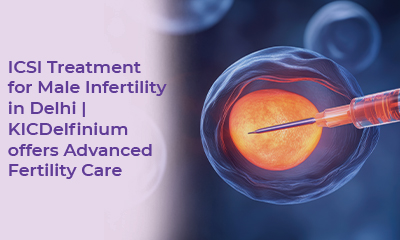
Male infertility is more common than most people realise. Research consistently shows that male factors contribute to roughly half of all cases of infertility among couples trying to conceive. Yet awareness remains low, diagnoses are often delayed, and many men do not know that highly effective treatments including ICSI (Intracytoplasmic Sperm Injection) now exist for even the most challenging sperm-related conditions.
At KICDelfinium, Delhi, our fertility specialists and andrologists are dedicated to providing personalised, evidence-based care that addresses male infertility at its root, while guiding couples toward the outcome they are striving for.
ICSI: The Science That Changed Male Infertility Treatment
Introduced in the early 1990s, ICSI transformed the fertility landscape by making biological fatherhood achievable for men who, a generation earlier, would have had no medical pathway to parenthood.
The procedure is elegantly precise: under powerful microscopic magnification, a single sperm is selected, drawn into a fine glass needle, and injected directly into a mature egg. This single step bypasses the multiple barriers that poor-quality or insufficient sperm face in natural conception the cervical mucus, the fallopian tube journey, and the egg’s outer layers making fertilisation possible regardless of sperm quantity or swimming ability.
At KICDelfinium, Delhi, ICSI is performed by highly experienced embryologists in a laboratory environment designed to maintain the strictest quality and safety standards, giving every egg the best possible chance of successful fertilisation.
Male Infertility in Delhi: Why It’s More Common Than You Think
Urban lifestyle factors prevalent in Delhi chronic work stress, sedentary habits, pollution exposure, smoking, excessive alcohol consumption, poor dietary patterns, and obesity are increasingly associated with declining sperm quality among men of reproductive age.
According to reproductive health data, semen parameters in Indian urban males have shown concerning trends over recent decades. Yet many men delay seeking help, either due to social stigma or simply because they are unaware that effective solutions exist.
At KICDelfinium, our first step is always a thorough, confidential evaluation. Understanding the specific cause of a man’s infertility allows us to tailor treatment precisely and ICSI, often in combination with other interventions, forms the cornerstone of that treatment for a large proportion of our Delhi patients.
Who Benefits from ICSI at KICDelfinium, Delhi?
Men with Quantitative Sperm Deficiencies:
- Mild to severe oligospermia (low sperm count below normal thresholds)
- Cryptozoospermia (extremely scarce sperm detectable only after processing)
Men with Qualitative Sperm Issues:
- Asthenospermia reduced progressive motility, preventing sperm from reaching an egg
- Teratospermia high proportion of morphologically abnormal sperm
- OAT syndrome the combination of all three parameters being compromised simultaneously
Men with Azoospermia:
- Obstructive azoospermia due to vasectomy, infection-related scarring, or congenital absence of the vas deferens
- Non-obstructive azoospermia due to testicular failure or very impaired spermatogenesis
Men with Functional or Genetic Sperm Issues:
- Elevated sperm DNA fragmentation a leading hidden cause of recurrent implantation failure and early miscarriage
- Antisperm antibody positivity immune-mediated sperm dysfunction
- Genetic conditions affecting sperm production (Klinefelter syndrome, Y-chromosome microdeletions)
Other Clinical Indications:
- Prior IVF cycle with zero or poor fertilisation
- Ejaculatory dysfunction (retrograde ejaculation)
- Sperm obtained from banking following cancer treatment
- Unexplained infertility in couples after standard IUI attempts
How ICSI Works: Your Treatment Pathway at KICDelfinium, Delhi
We believe every patient deserves to understand what lies ahead. Here is a detailed outline of your ICSI treatment journey with us in Delhi:
Phase 1: In-Depth Male Fertility Diagnosis
No treatment is prescribed without a thorough diagnostic picture. At KICDelfinium, male evaluation includes:
- Comprehensive semen analysis evaluated against WHO 2021 reference criteria
- Sperm DNA Fragmentation Index (DFI) assessed via TUNEL or SCSA assay
- Hormonal profiling serum FSH, LH, total testosterone, AMH, prolactin, thyroid
- Scrotal Doppler ultrasound to detect varicocele, testicular abnormalities
- Genetic testing karyotype analysis, Y-chromosome microdeletion panel (for azoospermic/severely oligospermic men)
- Transrectal ultrasound where ejaculatory duct obstruction is suspected
Phase 2: Female Partner Fertility Assessment
ICSI outcomes are influenced equally by egg quality and uterine environment. The female partner’s workup at our Delhi centre includes ovarian reserve testing, pelvic ultrasound, uterine cavity evaluation, and immunological assessments where clinically indicated.
Phase 3: Tailored Stimulation Protocol
The female partner undergoes controlled ovarian stimulation using gonadotropin injections tailored to her ovarian reserve and response. Our Delhi team monitors follicle development through serial ultrasounds and blood oestradiol levels, typically over 10 to12 days. Protocols are individualised not standardised to optimise egg yield while minimising the risk of ovarian hyperstimulation.
Phase 4: Oocyte Retrieval
When leading follicles reach maturity, eggs are collected via a transvaginal ultrasound-guided needle aspiration under light sedation. The procedure takes approximately 20 to 30 minutes. Mature (MII) oocytes are immediately handed to our embryology team.
Phase 5: Male Sperm Collection and Preparation
For most men, a fresh semen sample is produced on the same morning as egg retrieval. For men with azoospermia, ejaculatory dysfunction, or prior sperm banking, KICDelfinium’s andrologists perform:
- PESA (Percutaneous Epididymal Sperm Aspiration): Sperm aspirated from the epididymis under local anaesthesia preferred for obstructive azoospermia
- TESA (Testicular Sperm Aspiration): Fine-needle aspiration from testicular tissue used when epididymal retrieval is insufficient
- Micro-TESE (Microsurgical Testicular Sperm Extraction): An operating microscope-assisted open biopsy identifying rare sperm-producing tubules in non-obstructive azoospermia the most advanced and effective surgical sperm retrieval available
Phase 6: The ICSI Fertilisation Procedure
In our Delhi laboratory, the embryologist uses a micromanipulation system to individually examine each prepared sperm. The selected sperm assessed for morphology, motility pattern, and structural integrity is immobilised and aspirated into an injection pipette. Each mature egg is held in position and the sperm is delivered precisely into the cytoplasm. The entire process is performed with extraordinary technical skill and attention to detail.
Phase 7: Embryo Culture and Assessment
Fertilised eggs (now called zygotes) are incubated at physiological temperature and monitored through cleavage stages to the blastocyst stage (Day 5â6). Our embryologists grade each embryo using internationally standardised criteria to identify those with the highest implantation potential.
Phase 8: Embryo Transfer
The selected embryo(s) are gently transferred into the uterine cavity using a soft catheter under abdominal ultrasound guidance. A single high-quality blastocyst transfer is generally recommended to achieve a healthy singleton pregnancy while minimising multiple pregnancy risk.
Why KICDelfinium Stands Out Among Fertility Clinics in Delhi
Dedicated Male Fertility Programme
KICDelfinium operates a structured male fertility programme not merely an add-on to IVF services. From advanced diagnostics to surgical sperm retrieval and ICSI optimisation, male infertility receives the dedicated clinical focus it deserves.
Multidisciplinary Expertise
Our Delhi team brings together reproductive endocrinologists, andrologists, senior embryologists, genetic counsellors, and fertility nurses who coordinate closely to manage complex cases with precision.
State-of-the-Art Laboratory Standards
Our Delhi embryology laboratory maintains ISO-standard environmental controls and quality assurance protocols. Laboratory quality is not incidental to IVF/ICSI success it is fundamental to it.
FAQs ICSI and Male Infertility at KICDelfinium, Delhi
1: Is ICSI the right treatment for every man with infertility in Delhi?
⌄
Not always. For mild male factor infertility, IUI may be appropriate first. ICSI is the recommended approach when sperm count or motility is severely compromised, when azoospermia is present, or when prior IVF has failed due to poor fertilisation. Our specialists will guide you to the right treatment based on your specific diagnosis.
2: Can a man with non-obstructive azoospermia have biological children via ICSI?
⌄
In many cases, yes. Even in non-obstructive azoospermia, focal areas of spermatogenesis may persist in the testes. Micro-TESE, performed by our andrologists in Delhi, successfully retrieves sperm in a meaningful proportion of these patients, which can then be used in ICSI.
3: How does Delhi pollution affect male fertility, and what can be done before ICSI?⌄
Environmental pollutants, including PM2.5 and heavy metals present in Delhi’s air, have been associated with oxidative stress-related sperm damage. Before an ICSI cycle, we typically recommend 60â90 days of antioxidant supplementation, dietary adjustments, reduced outdoor pollution exposure, and avoidance of heat sources near the scrotum.
4: What is the cost of ICSI treatment at KICDelfinium in Delhi?
⌄
ICSI costs in Delhi vary based on the specific protocol, the need for surgical sperm retrieval, and any additional techniques like PGT or IMSI. During your consultation at our Delhi centre, our team provides complete cost transparency with itemised estimates no surprises.
5: How soon can I begin ICSI treatment at KICDelfinium?
⌄
Following your initial consultation and diagnostic workup, ICSI can typically begin within the subsequent menstrual cycle if both partners are cleared for treatment. Our team works to minimise unnecessary delays for patients who are ready to proceed.